
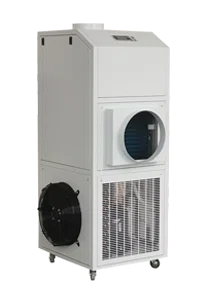
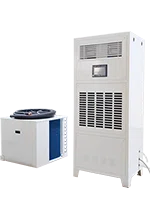
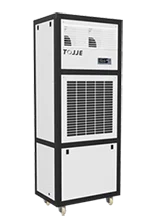
Factory Dehumidifier Reaching −40°C Dew Point at Scale
In industries such as lithium-ion battery manufacturing, pharmaceutical production, electronics assembly, and specialty chemical processing, controlling humidity is essential for product quality, process stability, and equipment reliability. Standard air-conditioning systems can maintain comfortable indoor conditions, but they are generally not designed to deliver the extremely dry air required by moisture-sensitive manufacturing processes.
A factory dehumidifier designed to achieve a −40°C dew point provides a solution for industrial environments that require very low moisture levels. At this dew point, the air contains substantially less water vapor than ordinary conditioned air, helping manufacturers control moisture exposure across production lines, material storage areas, and specialized process rooms.
Desiccant Wheel Technology for Ultra-Low Dew Points
The desiccant wheel is one of the most important components in a factory dehumidifier designed for very dry air.
Its performance depends on the adsorption properties of the desiccant, wheel geometry, rotational speed, airflow distribution, regeneration temperature, and the sealing between process and regeneration sections.
Desiccant Material Selection
Different desiccants have different adsorption characteristics and operating limits.
Silica gel is widely used in industrial dehumidification because of its moisture adsorption properties and established applications. Other desiccant materials may be selected according to the required dew point, regeneration conditions, contamination constraints, and equipment design.
Material selection should be based on verified performance data rather than a general assumption that one desiccant is always superior.
Regeneration Temperature and Energy Use
The regeneration process supplies heat to remove adsorbed moisture from the desiccant.
Insufficient regeneration can reduce moisture-removal capacity and cause supply-air dew point to rise. Excessive regeneration temperature, on the other hand, may increase energy consumption and place unnecessary thermal stress on system components.
The appropriate temperature depends on the desiccant material, wheel construction, airflow, and the manufacturer's validated operating range.
Heat recovery and efficient regeneration-air management can help reduce energy consumption in large industrial installations.
Sealing and Airflow Distribution
Leakage between process and regeneration sections can allow warm, moisture-rich air to contaminate the dry-air stream.
Poor airflow distribution can also reduce the effective use of the desiccant surface and create inconsistent performance across the wheel.
Routine inspection should therefore include seals, filters, fans, wheel drive systems, and air distribution components.
Factory Layout and Dry Room Integration
A dehumidifier cannot maintain a −40°C dew point efficiently if the surrounding building and air-distribution system continuously introduce excessive moisture.
Improve Building Airtightness
Doors, access panels, utility penetrations, and wall joints can become pathways for humid air infiltration.
Reducing uncontrolled leakage helps lower the dehumidification load and improves the stability of room conditions.
Airlocks, fast-closing doors, and appropriate personnel entry procedures may be useful where operational requirements justify them.
Maintain Appropriate Room Pressure
Dry rooms are often operated with a controlled pressure relationship to adjacent areas to help manage air movement.
The correct pressure strategy depends on the process, building configuration, safety requirements, and contamination-control objectives. Positive pressure may help reduce inward infiltration in some applications, but it must be balanced against adjacent-room requirements and other safety considerations.
Pressure differences should be measured and monitored rather than assumed from fan settings alone.
Optimize Dry-Air Distribution
Supply-air ducts and return-air paths should be designed to distribute dry air effectively across the controlled area.
Poorly placed supply outlets, short-circuiting between supply and return air, or obstructed airflow can create local moisture variations even when the dehumidifier itself performs correctly.
Computational modeling, airflow measurements, and commissioning tests can help identify distribution problems.
Energy Efficiency in Large-Scale Dehumidification
Achieving a very low dew point requires energy for air movement, moisture adsorption, regeneration, and often cooling. At factory scale, energy consumption can become a major operating expense.
The most effective strategy is to reduce unnecessary moisture loads before increasing dehumidifier output.
Reduce Unnecessary Outdoor Air Intake
Outdoor air may carry a large moisture load, especially in humid climates. Ventilation should meet applicable process, occupational, and building requirements without introducing avoidable excess air.
Where permitted, appropriately designed air recirculation can reduce the amount of new moisture entering the system.
Recover Waste Heat
Some systems can recover suitable waste heat to support regeneration or preheat regeneration air.
The feasibility depends on the temperature and availability of the heat source, the required regeneration conditions, and the design of the heat-recovery system.
Heat recovery should be evaluated using a complete energy balance, including additional fan power, heat-exchanger performance, and maintenance requirements.
Use Variable-Speed Control Where Appropriate
Variable-speed fans, pumps, and wheel drives can help match system operation to actual demand when the equipment and process permit variable operation.
Control strategies should maintain the required dew point and airflow distribution while avoiding unnecessary energy use.
Monitor Specific Energy Consumption
Track energy consumption alongside moisture-removal performance.
Useful indicators include electricity use per unit of dry-air volume, regeneration energy per unit of water removed, and total system energy consumption during representative production periods.
Comparisons should use consistent operating conditions so that apparent efficiency improvements do not simply reflect lower moisture loads or reduced production.
Monitoring and Control for Stable −40°C Dew Point Performance
Continuous monitoring is essential when a factory depends on ultra-dry air for product quality.
A well-designed control system combines moisture measurement with equipment operating data and appropriate alarms.
Dew Point Sensors
Dew point sensors should be selected for the intended measurement range, accuracy, response time, pressure conditions, and environmental compatibility.
Sensor placement is important. Supply-air measurements indicate the condition delivered by the dehumidifier, while room measurements show whether the controlled space is maintaining the required environmental condition.
Return-air measurements can provide additional information about moisture entering the system.
These measurements serve different purposes and should be interpreted together.
Differential Pressure Monitoring
Differential pressure sensors help verify pressure relationships between the dry room and adjacent spaces.
Unexpected changes may indicate door activity, filter loading, fan problems, or air-distribution issues that affect moisture control.
Regeneration and Equipment Monitoring
Important operating variables include regeneration temperature, process-air temperature, airflow, fan status, wheel rotation, filter pressure drop, and relevant alarm conditions.
When these parameters are recorded alongside dew point data, maintenance teams can identify performance degradation before it develops into a production problem.
Data Logging and Predictive Maintenance
Connecting the dehumidifier to a building management system or industrial control platform allows operators to review trends, identify recurring moisture spikes, and investigate the causes of performance changes.
For example, a gradual increase in supply-air dew point may justify checking regeneration performance, wheel condition, air leakage, or sensor calibration.
Data analysis can support predictive maintenance, but alerts should be based on validated operating limits and verified fault patterns.
Factory Dehumidifiers for Lithium-Ion Battery Manufacturing
Lithium-ion battery manufacturing is a prominent application for ultra-low-dew-point environments because moisture can interfere with sensitive materials and manufacturing steps.
Depending on the chemistry and production stage, moisture exposure may affect electrode materials, electrolyte handling, cell assembly, and product consistency.
A factory dehumidifier can help establish the controlled environment required by these processes. However, the appropriate dew point varies by production step, material specification, and manufacturing design.
Electrode and Cell Assembly Areas
Different stages of battery production may have different moisture-control requirements. The dehumidification system should be designed around the specific process rather than applying the same target to every room.
Where −40°C dew point is required, engineers must consider the moisture released by materials and equipment, air leakage, worker movement, and process ventilation.
Preventing Moisture Ingress
Material transfer and personnel movement can introduce moisture into dry rooms.
Airlocks, controlled transfer procedures, appropriate packaging, and well-managed access points help reduce these loads.
A dehumidifier is only one part of the overall moisture-control strategy. Building design, material handling, production scheduling, and operator procedures all contribute to stable performance.
Achieving a −40°C dew point at factory scale requires more than installing a high-capacity dehumidifier. It depends on accurate moisture-load calculations, appropriate desiccant technology, efficient regeneration, well-designed airflow distribution, building airtightness, and reliable monitoring.