
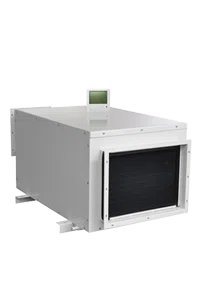
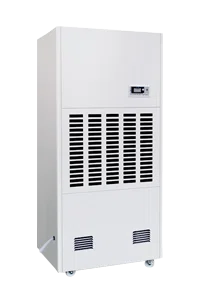
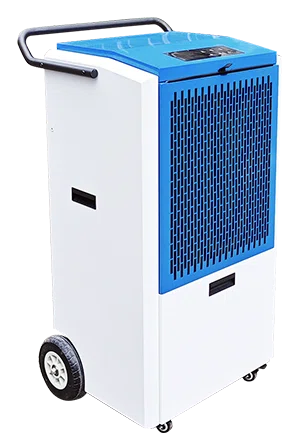
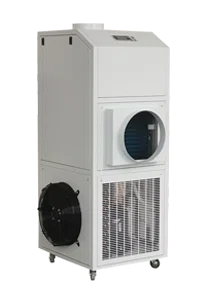
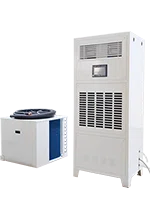
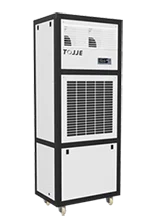
Rotary Desiccant Dehumidifier for Plastics and Polymer Processing
Moisture is the quietest cause of scrap in plastics processing. It does not announce itself with an alarm — it shows up as silver streaks on a moulded part, bubbles in a thick section, a drop in impact strength, or a batch of PET preforms that fails on acetaldehyde. By the time the defect appears, the resin has already been damaged, often irreversibly.
The reason is chemistry. Most engineering resins are hygroscopic: they absorb water from the air into the polymer structure itself. Once absorbed, that water cannot be removed by heating alone at any practical temperature — it has to be driven out by air that is drier than the resin. That is the job of a rotary desiccant dehumidifier, and it is why the drying air's dew point, not its temperature, is the number that decides whether a process runs clean.
Why Dry Air Matters More Than Dry Resin
Three mechanisms explain almost every moisture-related defect:
- Hydrolysis. In condensation polymers — PET, PA, PC, PBT — water reacts with the polymer chain at melt temperature and breaks it. Molecular weight drops, intrinsic viscosity falls, and mechanical properties go with it. The damage is permanent: you cannot dry your way back to the original resin.
- Volatilisation at the screw. Absorbed moisture flashes to steam in the barrel, creating bubbles, voids, and the classic silver-streak splay on the surface.
- Dimensional and surface effects. Residual moisture changes shrinkage, warpage, gloss, and weld-line strength — defects that are blamed on the tool far more often than on the dryer.
Refrigeration rotary desiccant dehumidifiers, which cool air to condense water out, realistically reach dew points around 5–10 °C. That is fine for comfort cooling and warehouse humidity, and nowhere near enough for hygroscopic resin drying. A desiccant wheel reaches −20 °C to −40 °C dew point routinely, and −60 °C with molecular sieve rotors — which is why the technology dominates plastics drying rather than competing with cooling-based systems.
Integrating With Hoppers, Conveying, and Return Air
A desiccant unit is only as good as the loop it sits in:
- Closed-loop return. Returning dry air from the hopper to the rotary desiccant dehumidifier is what makes low dew points economic — you are drying air that is already dry. Open-loop designs must condition fresh ambient air continuously and cost far more to run.
- Filtration before the wheel. Resin dust is the enemy of a desiccant rotor: it blinds the honeycomb, raises pressure drop and destroys capacity. Filter the return air properly and monitor differential pressure.
- Dew point sensor placement. Measure at the hopper inlet, after the rotary desiccant dehumidifier and after any temperature rise — not at the unit outlet. A sensor in the wrong place reports a good dew point while the hopper receives humid air.
- Hopper insulation and sealing. Uninsulated hoppers condense moisture on internal surfaces; leaking lids and inspection ports let ambient air in faster than the dryer can compensate.
- Over-drying. Running far below target dew point wastes energy and, in some resins, causes brittleness or static problems. Dry to specification, not to the driest number the machine can reach.
Energy: Where the Cost Actually Sits
Operating cost is dominated by regeneration heat, not by the wheel motor. Three practical levers:
- Closed-loop return air reduces the latent load the wheel must remove — often the single largest saving available.
- Heat recovery from the regeneration exhaust preheats incoming regeneration air.
- Right-sizing. An oversized unit running at part load still regenerates; a correctly sized unit with a variable-speed drive on the process fan performs better across the shift.
Compared with compressed-air membrane dryers, a desiccant wheel is generally more energy-efficient at high flows and lower dew points; compared with vacuum dryers, it wins on throughput and loses on ultimate dryness. The comparison worth making is against your actual duty cycle, not against catalogue headline figures.
Five Mistakes That Undermine a Good Rotary Desiccant Dehumidifier
- Specifying airflow instead of dew point at the hopper inlet. The hopper is the point of use.
- Ignoring return-air filtration. A fouled rotor loses capacity gradually — the defect rate climbs before anyone suspects the dryer.
- Drying too hot to save time. Above the resin's safe temperature, caking and degradation replace moisture as the defect source.
- Trusting the incoming moisture figure. Regrind, recycled material, and humid storage change it substantially.
- No data. Without dew point and moisture logs, every moisture defect becomes an argument instead of a diagnosis.
In polymer processing, the rotary desiccant dehumidifier is not an accessory to the dryer — it is the drying process. Dew point at the hopper inlet decides whether hydrolysis happens; airflow and residence time decide whether the moisture actually leaves; filtration, insulation, and sensor placement decide whether it keeps working next month. Size to the resin's specification rather than to a nameplate, close the loop, and log the data: that combination is what separates a clean process from a defect investigation.