
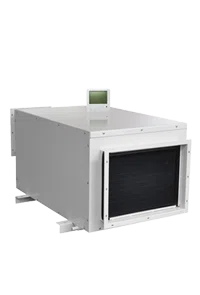
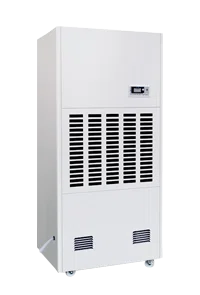
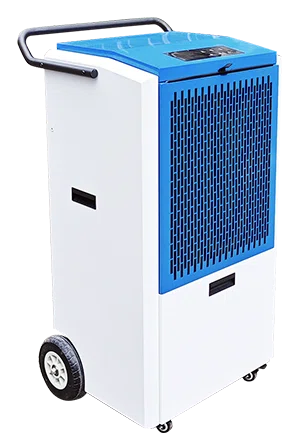
Running a Workshop Dehumidifier in a Garage With No Heating
A garage without heating can be a challenging environment for controlling moisture, especially during winter, rainy seasons, or periods of high humidity. Cold temperatures, condensation, and limited ventilation can create ideal conditions for rust, mold, mildew, and damage to tools, machinery, and stored materials. For homeowners, mechanics, and workshop operators, maintaining a suitable humidity level is essential for protecting equipment and keeping the workspace in good condition.
Running a workshop dehumidifier in an unheated garage can help control excess moisture, but selecting the right equipment and operating it correctly are critical. Temperature affects dehumidifier performance, so understanding how different technologies work in cold environments can help you achieve better moisture control with less wasted energy.
Can You Run a Workshop Dehumidifier Without Heating?
Yes. A workshop dehumidifier can operate in an unheated garage, but its effectiveness depends on the ambient temperature and the type of dehumidification technology used.
Not all dehumidifiers perform equally well in cold environments. Choosing a unit based only on its advertised moisture-removal capacity can lead to disappointing results if the garage temperature frequently falls below the manufacturer's recommended operating range.
Two common technologies are refrigerant dehumidifiers and desiccant dehumidifiers.
1. Refrigerant Dehumidifiers
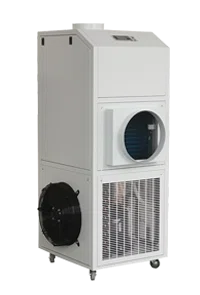
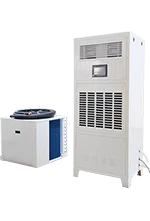
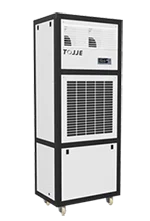
Refrigerant dehumidifiers draw humid air across a cold evaporator coil. Water vapor condenses on the coil, and the collected water drains into a tank or through a drainage hose.
These units are often energy-efficient in moderately warm and humid environments. However, their performance typically decreases as temperatures fall because cold air contains less moisture and the evaporator coil may develop frost.
Many refrigerant models include automatic defrost functions to manage frost accumulation. Nevertheless, defrost cycles can reduce effective moisture-removal time, particularly in cold garages.
Before purchasing a refrigerant dehumidifier, check its minimum operating temperature and moisture-removal performance at the temperatures your garage actually experiences.
2. Desiccant Dehumidifiers
Desiccant dehumidifiers use moisture-absorbing materials to remove water vapor from the air. The desiccant is regenerated using heat, allowing the unit to continue absorbing moisture during operation.
Unlike conventional refrigerant models, desiccant systems do not rely on cooling air below its dew point to collect moisture. This makes them particularly useful in many low-temperature environments.
Potential advantages include:
-
More consistent moisture removal at low ambient temperatures.
-
Effective operation in cold workshops and storage areas when the unit is rated for those conditions.
-
The ability to achieve low humidity levels in applications requiring tighter moisture control.
-
No dependence on a conventional refrigeration evaporator coil for moisture capture.
However, desiccant dehumidifiers may consume more energy than refrigerant models in warmer conditions. Their suitability depends on the required humidity level, ambient temperature, airflow, and operating schedule.
For garages that remain cold for extended periods, a low-temperature-rated desiccant dehumidifier may be a practical alternative to adding permanent heating.
Best Practices for Operating a Dehumidifier in a Cold Garage
Even a well-selected dehumidifier will perform poorly if the surrounding conditions allow moisture to enter continuously.
Improve Air Sealing
Inspect garage doors, windows, wall joints, and other openings for gaps. Sealing unnecessary air leaks can reduce the entry of humid outdoor air and improve the efficiency of moisture control.
Complete sealing may not be appropriate for every workshop, especially where fuel-burning equipment, chemicals, or other activities require ventilation. Follow applicable ventilation and safety requirements.
Keep the Air Circulating
Place the dehumidifier where air can move freely through its intake and outlet. Avoid positioning it tightly against walls or behind stored equipment.
If certain corners remain damp, a separate circulation fan may help distribute air more evenly. However, a fan alone does not remove moisture from the garage.
Reduce Water Brought Inside
Wipe down wet vehicles, tools, and equipment when practical. Use suitable floor mats or collection trays to manage water from vehicles and avoid leaving wet materials in enclosed storage areas.
If moisture enters through a leaking roof, damaged wall, or wet foundation, repair the source rather than relying exclusively on the dehumidifier.
Monitor Temperature and Humidity
A separate digital thermo-hygrometer can help track conditions in the garage. Recording temperature and relative humidity over several days can reveal when moisture problems occur and whether the dehumidifier is maintaining the desired conditions.
Remember that relative humidity changes with temperature. A lower relative humidity reading does not always mean that moisture has been removed from the air, particularly when the garage warms up or cools down.
Position the Unit Away from Direct Water Exposure
Workshop environments may contain splashing water, dust, oil mist, and metal particles. Position the equipment on a stable, level surface and follow the manufacturer's requirements for electrical protection, clearances, and environmental conditions.
Use an appropriately rated electrical supply and avoid unsafe extension-cord arrangements in damp areas.
Running a workshop dehumidifier in an unheated garage is an effective way to reduce condensation, protect tools, and maintain a more stable storage environment. The key is to choose equipment that matches the garage's temperature range and moisture load.
Refrigerant dehumidifiers can be economical in moderately warm conditions, while low-temperature-rated desiccant models may be better suited to persistently cold environments. Proper drainage, good air circulation, humidity monitoring, and repairs to moisture sources further improve performance.
By combining suitable equipment with practical moisture-control measures, garage owners and workshop operators can reduce corrosion risks and protect valuable equipment without necessarily installing a permanent heating system.